
A Window into Newman and Papal Infallibility at Vatican I


The First Vatican Council began on the Feast of the Immaculate Conception, 08 December 1869, with around 700 bishops, cardinals, abbots, and theologians present. Newman was invited by Pope Pius IX (r. 1846–1878) to attend the council as a theologian, but he asked William Bernard Ullathorne (1806–1889) to decline the invitation on his behalf, citing his poor health and his inability to speak any language but English.1 Before the council, five subsidiary commissions were created to prepare materials on: 1) faith and dogma, 2) ecclesiastical discipline and canon law, 3) religious orders and regulars, 4) Oriental churches and foreign missions, and 5) politico-ecclesiastical affairs. Despite being absent from the council’s initial list of considerations, debates surrounding the pope’s temporal powers and infallibility quickly picked up among clergy and lay people alike.2 There were strong disagreements between the Gallicans, who minimized certain political and theological papal claims across history, and the Ultramontanists, who believed that the pope has absolute authority in the church. These debates eventually reached the First Vatican Council, which is primarily known today for its definition of papal infallibility.
The NINS Digital Collections houses letters between Newman and Ullathorne that can shed light on their views of the council. The first letter we have in the NINS Digital Collections from Ullathorne to Newman during Vatican I is dated 20 January 1870. In it, Ullathorne told Newman that he felt “unworthily” elected to the reform of canon law, gave his general impressions of the council and its attendees, and expressed his disapproval of activities and petitions occurring outside of the council. Newman’s response to this letter, dated 28 January 1870, caused a stir at the First Vatican Council for his remarks about defining papal infallibility. He wrote:
Why should an agressive [sic] insolent faction be allowed to ‘make the heart of the just mourn, whom the Lord hath not made sorrowful?’ Why can’t we be left alone … If it is God’s will that the Pope’s infallibility should be defined, then it is his blessed Will to throw back ‘the times and the moments’ of that triumph which He has destined for His Kingdom.
While Newman supported papal infallibility, he worried that an official definition would overburden Catholic converts, and he wished the topic to be put off for a later discussion. He later told Sir John Simeon in a letter dated 27 March 1870 that this reply to Ullathorne’s letter was “one of the most passionate and confidential letters that [he] ever wrote in [his] life.” However, this letter did not remain confidential.
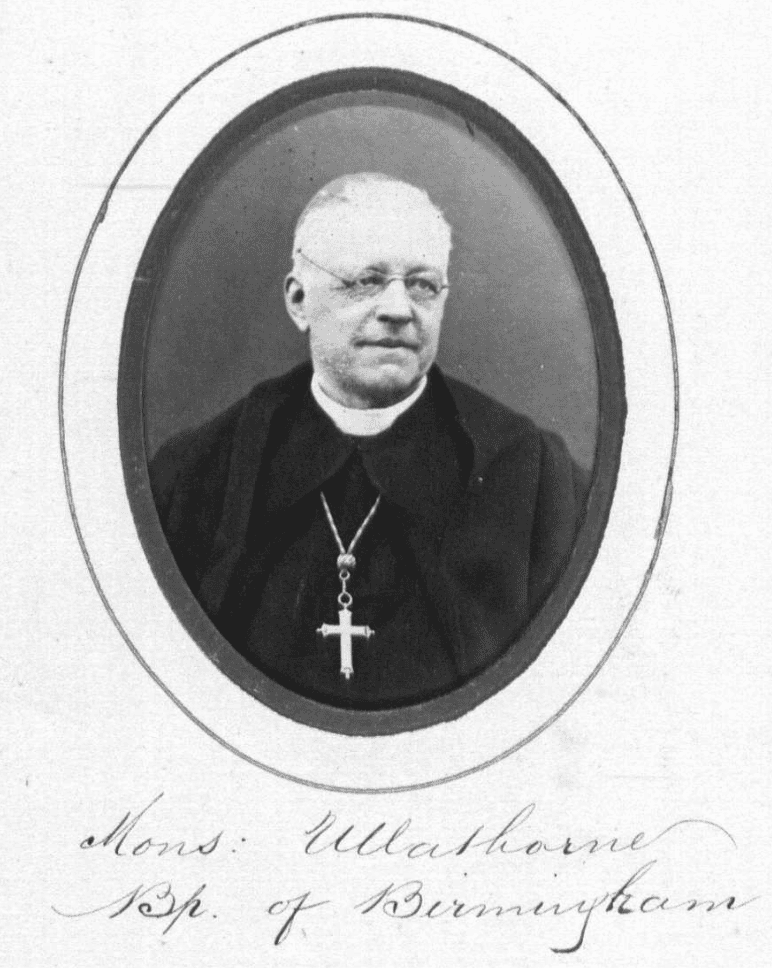
Ullathorne wrote to Newman on 04 February 1870 thanking him for the heartfelt reply and to provide further details about the progression of the infallibility debates in the council. The issue had not been formally brought up in the council chamber, but many documents were being signed and shared among the bishops there. Ullathorne publicly refused to be a part of any outside movements, but he privately supported a “calm and moderate definition, provided it was duly balanced by strengthening the authority of the Episcopate.” Ullathorne was confident that moderation would prevail in these debates and assured Newman of this fact.
If you could but see, as I see, schemata brought in, only to be pulled to pieces, and sent out again, bleeding in every limb, to be reconstructed by the special committees, by the light given in the Council; you would realise how the general sense of the fathers prevails over all party views and idyonsincracies [sic].
On 09 February 1870, Newman thanked Ullathorne for his detailed letter, and still feeling anxious, expressed his need to “have a little more faith.” On 14 March 1870, Newman immediately wrote to Ullathorne after The Protestant Standard published this passage regarding Newman’s 28 January 1870 letter:
It will interest many people to know that Dr Newman has written to his Bishop at Rome, stigmatizing the promoters of Papal Infallibility as an insolent, aggressive faction, praying that God may avert this threatened peril from the Church, and affirming his conviction that, if He does not see fit to do so, it is because He has chosen to delay the Church’s ultimate triumph for centuries.3
Ullathorne replied on 18 March 1870 to express his distress at Newman’s letter having gotten out, and explained that though he did show the letter to some bishops, he expressly forbade them from showing the contents to others without his consent. However, Bishop William Clifford copied Newman’s letter when it was left with him overnight, much to Ullathorne’s annoyance. When news of Newman’s leaked letter reached Ullathorne, he confronted Bishop Clifford about his culpability in the matter.
I went to Fr. Clifford, and told him of what I had heard and expressed my conviction that he, and he alone, could have let it out. He assured me in most solemn terms that no one could have seen or taken a copy of his copy. This is all I know about it … I am, I repeat it, very much distressed at what has happened, and see but one channel through which it could have got into anyones [sic] hands.
Rumors also spread about Newman’s 28 January 1870 letter to Bishop David Moriarty regarding the definition of papal infallibility. Bishop Moriarty approached Ullathorne and asked if it would be wise to translate Newman’s 28 January 1870 letter for Cardinal Barili to read, but he refused, believing passages from the letter would be taken out of context and used to harm Newman’s reputation. He further cautioned Moriarty to guard his own letter from Newman and to prevent its dissemination. After providing Newman all the information he had, Ullathorne instructed him to “take whatever course you think most prudent.” Newman’s response on 22 March 1870, thanked Ullathorne for his concern, but Newman seemed rather unperturbed by the situation, writing, “I have had too many knocks to care for this and I don’t see on the whole harm will come of it.”
Indeed, it does not appear that much harm came to Newman at Vatican I because of this letter. Ullathorne wrote that no one at the council had mentioned Newman’s 28 January 1870 letter except to express their regret that it had been disseminated without the involved parties’ consent. In fact, many members of the council thought highly of Newman and regarded his work as exceptional. Ullathorne told Newman in his 01 June 1870 letter that an Italian prelate even quoted his work during the debates on infallibility, which raged inside the council while violence leading up to the Franco-Prussian War was steadily rising outside. Ullathorne said on 01 June 1870, “The police too are very active here, as Sunday suspicious persons are about, and an attempt was really made to mine a barrack.”
At the end of long and passionate discussions, Pastor Aeternus was approved on the last day of Vatican I and promulgated on 18 July 1870. Just two months later, on 20 September 1870, Rome was captured by Italian troops, marking the end of the Papal States. A month later, on 20 October 1870, the First Vatican Council was suspended indefinitely by Pope Pius IX.4 The last approved document from Vatican I, Pastor Aeternus, was a dogmatic constitution that defined the primacy of the pope and papal infallibility. Below is an excerpt on infallibility:
We teach and define as a divinely revealed dogma that when the Roman pontiff speaks ex cathedra, that is, when, in the exercise of his office as shepherd and teacher of all Christians, in virtue of his supreme apostolic authority, he defines a doctrine concerning faith or morals to be held by the whole Church, he possesses, by the divine assistance promised to him in blessed Peter, that infallibility which the divine Redeemer willed His Church to enjoy in defining doctrine concerning faith or morals. Therefore, such definitions of the Roman Pontiff are of themselves, and not by the consent of the Church, irreformable.5
After the First Vatican Council, many bishops published pastoral letters interpreting papal infallibility for their dioceses. Ullathorne’s pastoral letter on this topic, published in October 1870, was received positively in Rome and corroborated by Josef Fessler, Secretary of the First Vatican Council. In it, Ullathorne took a moderate approach by emphasizing that papal infallibility only applies when certain conditions are met as defined by the council and that the occasions for such proclamations are limited.6
The correspondence between Ullathorne and Newman serves as an entry point for exploring the complex debates surrounding papal infallibility both inside and outside of the First Vatican Council. From these letters, contemporary readers get a sense of the tension at the council and are introduced to other important people during this period. There are many more resources available in the NINS Digital Collections to deepen your knowledge of other people and events at Vatican I.
1 Dom Cuthbert Butler, The Vatican Council 1869–1870: Based on Bishop Ullathorne’s Letters (The Newman Press, 1962), 69–74.
2 Dom Cuthbert Butler, The Life and Times of Bishop Ullathorne 1806–1889 (Burns Oates and Washbourne Ltd., 1926), 2:46–47. See also John Henry Newman to William Bernard Ullathorne (15 October 1868), LD, 24:163.
3 John Henry Newman to WIlliam Bernard Ullathorne (14 March 1870), LD, 25:53.
4 “Decrees of the First Vatican Council,” Papal Encyclicals Online.
5 Butler, The Vatican Council 1869–1870, 412–16.
6 Butler, The Vatican Council 1869–1870, 455–61.

Angela Baker
Angela Baker was an intern at the National Institute for Newman Studies (NINS) during the summer of 2024, and now serves as the Digital Humanities and Editorial Specialist at NINS.
Topics
Newsletter

National Institute for Newman Studies
QUICK LINKS