
Discovering a New Newman Letter in an Undergraduate Seminar


Teaching Newman to undergraduates has yielded unexpected research rewards. Thanks in part to students in my St. John Henry Newman Seminar, the NINS Digital Collections has recently added a previously unknown letter, written 8 November 1845 from Newman to Rev. Joseph Oldknow, Perpetual Curate of Holy Trinity, Bordesley, Birmingham. My students and I may have been the first to examine the letter since its donation several years ago to the St. John the Evangelist Library of Christendom College, by William H. Marshner, Professor Emeritus of Theology. When the Director of the Library, Andrew V. Armstrong, learned of the course, he let me know about the manuscript and suggested that I examine it.
One morning, therefore, we set aside our normal class agenda and asked to see the letter. Noting its date, we realized the potential significance of any letter Newman penned in the weeks after his entry into Roman communion on 9 October 1845. Because we had read much of Msgr. Roderick Strange’s collection John Henry Newman: A Portrait in Letters, the students were already familiar with Newman’s epistolary style.1 Some of them had also recently practiced paleography in a course taught by my colleague Michael B. Kelly, and student Anne Cummings, if I recall, quickly deciphered for us a final pesky word.
The full text of the letter reads as follows:
Littlemore, Nov 8, 1845
My dear Sir
I left Oscott for this place on Monday morning, & did not receive your letter for some days after.
This will explain why you did not receive any answer to it. I felt much obliged by your kind invitation, and would gladly have availed myself of it, if I had had the opportunity
With every friendly feeling I am,
My dear Sir,
Very truly yours
John H Newman
On the reverse is a note in another hand: “This note was, I believe, written to Dr. Oldknow, now (1874) Vicar of Holy Trinity Church, Bordesley.”
We know little of the manuscript’s provenance. Dr. Marshner reported having bought it from Mr. Bruce Hacker, of Front Royal, VA, who formerly owned an antiquities business. Mr. Hacker reported having originally purchased the letter in St. Louis from a rare books dealer who had himself come from England. He did not have the seller’s name or any further record of the manuscript’s history.
The note that Oldknow was the recipient appears highly reliable. Newman’s manuscript diary for the surrounding days confirms a letter received from Oldknow on Thursday 6 November and a reply to Oldknow on Sunday 9 November. (A one-day discrepancy is inconsequential, as exampled by a letter to Samuel Wilks similarly dated 8 November and noted under 9 November in the diary.2)
The letter adds insight into Newman’s flurry of activity in the weeks after entering Roman communion. As Lawrence Gregory noted to me, “every letter is a piece of the jigsaw, which we are assembling, particularly something like this dating from one of the most significant weeks in Newman’s religious history.”3 Newman’s visit to Oscott, the Roman Catholic seminary in Birmingham, from 31 October through Monday 3 Monday, had been the occasion of his confirmation, as well as further consultation with Nicholas Wiseman (future Cardinal-Archbishop of Westminster and then president of the seminary and Vicar Apostolic of the Midland District) regarding the clerical future of Newman and his newly Catholic companions. Wiseman took him to see the seminary’s old building (Old Oscott), which would become the group’s first home (Maryvale) after they left Littlemore.4 He also then told Newman to publish An Essay on the Development of Christian Doctrine without review by himself or other Catholic authorities.5
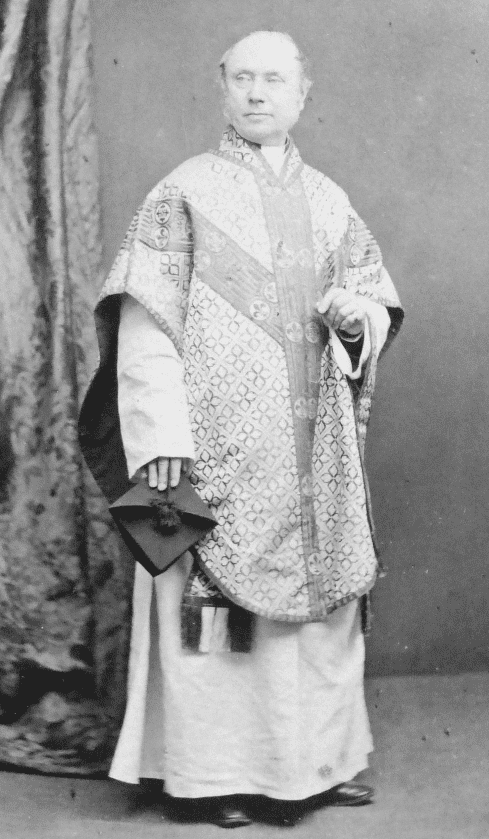
Dr. Oldknow, who remained vicar at Holy Trinity in Bordesley, Birmingham until his death in 1874, had previously met and corresponded with Newman, and his conscience held him fast as an Anglo-Catholic within the Church of England. His original invitation to Newman, clearly to meet while the latter was in the area, is likely lost. Newman’s friendly reply, in any event, is consistent with other correspondence in which he was willing to explain himself to Anglicans saddened by his choice to leave the established church.
The mutual respect and friendliness between Newman and Oldknow are evident from an exchange of letters a few months earlier. Oldknow related the defection to Rome of one of his flock and apologetically asked the truth of a worrying claim. In a letter dated 23 May 1845, Oldknow wrote that clergy of St. Chad’s Roman Catholic Cathedral in Birmingham, the unnamed man had said, had asserted that Newman had positively expressed his intention to join the Church of Rome. Newman, vexed by a falsehood stated so confidently by men could not possibly know his mind, was nevertheless willing to be “candid” with Oldknow, telling him “in confidence” of his present doubts: “There seems far more reason to say that the Church of England is in schism than that the peculiar doctrines of the Church of Rome are not developments.” Newman, hating rumor and desiring privacy to work through his struggles, still obliged Oldknow and trusted in the latter’s discretion.
Shortly after the men missed one another in Birmingham, Oldknow expressed his own anxieties and convictions in a sermon delivered on Sunday 9 November, soon published in pamphlet form as Grounds for abiding in the Church of England. He sought not to deny the “imperfection” of the Church of England but “to show that she has with her the Presence of Christ, that she has in her the means of salvation; and if only this can be shown, then must it be the duty of all her members to remain faithful to her, thankful for the blessings which they have received through her, and obedient to the spiritual rulers whom God has set over them within her.”6
It has been exciting to bring this unknown letter to light, with the help of my students, of Dr. Marshner and Mr. Hacker, of the staff of the St. John the Evangelist Library (especially Andrew Armstrong, Roberta Peer, and Stephen Pilon), and of Lawrence Gregory and Elizabeth Huddleston at NINS. The manuscript has prompted me to pursue further research into Oldknow and Newman’s interactions, both before and after 9 October 1845. Oldknow was a pioneer in ritualism and in ecumenism, and this line of inquiry will enhance our local Birmingham perspective on Newman’s relationship with ritualists and other Anglo-Catholics. Newman repeatedly wrote about neighborly charity. It will be illuminating to see how this played out in the relation to a charitable gentleman who was building an Anglo-Catholic enclave in the city wherein Newman was helping build the infrastructure of English Roman Catholicism.
1 John Henry Newman, John Henry Newman : A Portrait in Letters, ed. Roderick Strange (Oxford University Press, 2015).
2 LD, 11:27–28.
3 Private email.
4 LD, 11:24.
5 LD, 11:23.
6 Joseph Oldknow, Grounds for Abiding in the Church of England (Francis and John Rivington, 1845), 4–5.
Share

Christopher John Lane
Christopher John Lane is Professor of History at Christendom College, Front Royal, VA. His work may be found at christopherjohnlane.com
Topics
Newsletter

National Institute for Newman Studies
QUICK LINKS