
A Truculent Inopportunist: Bishop Clifford, Cardinal Newman, and Papal Infallibility as Dogma


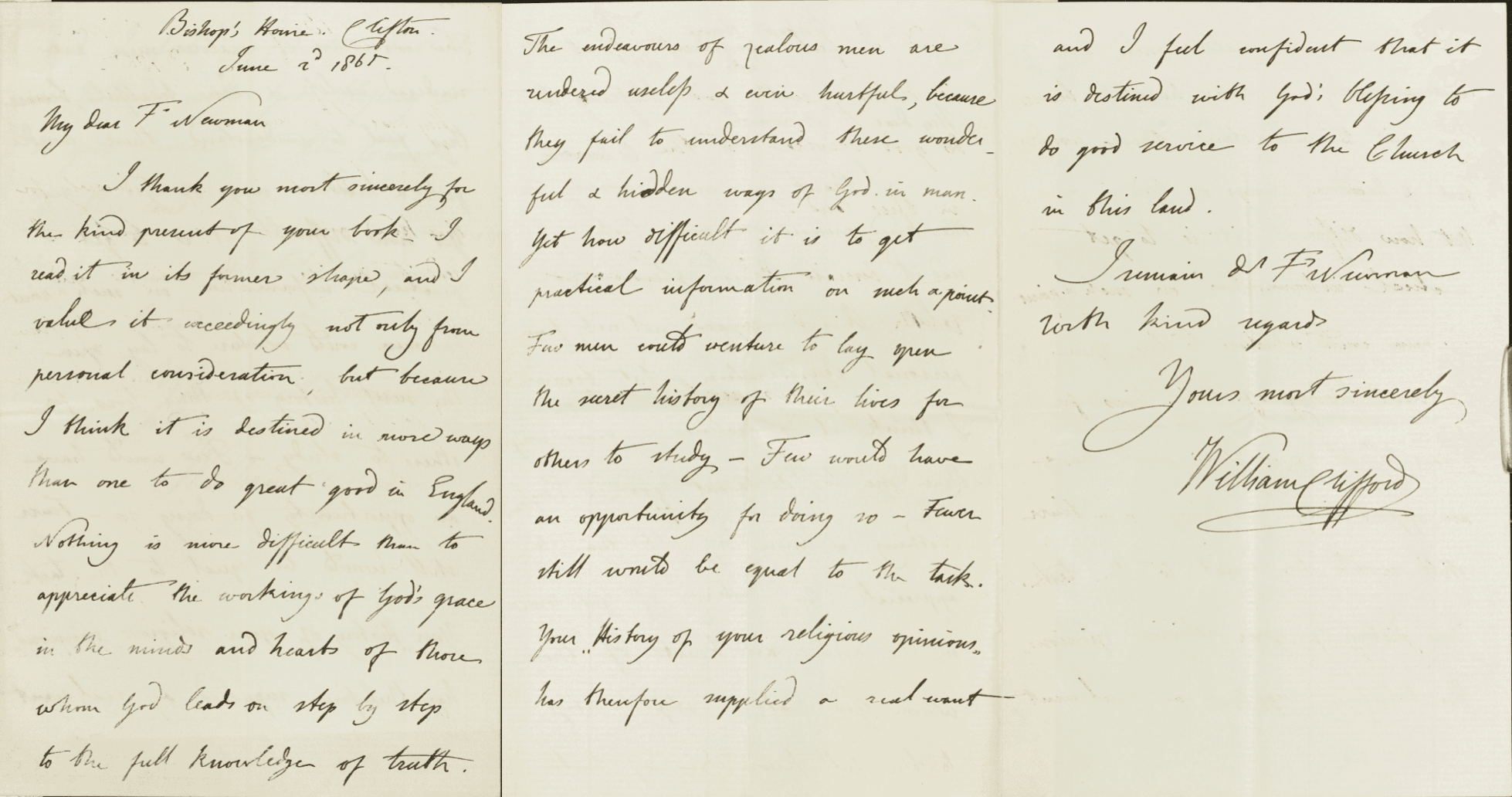
Bishop William Clifford1 was the bridge between conflicting philosophies in the English Catholic Church. He often acted as a go-between for Henry Manning, John Henry Newman, and Nicholas Wiseman, and despite familial ties to Herbert Vaughan, he was one of Newman’s most ardent supporters. They formed a close friendship, and Clifford was a constant correspondent during Newman’s life as a Catholic: he served at Newman’s first Mass, read the biglietto upon Newman’s elevation to the cardinalate, and delivered the eulogy at Newman’s funeral.2 Recently transcribed letters from the NINS Digital Collections demonstrate that of all the bishops who corresponded with Newman, Clifford was one of Newman’s most loyal allies in the English Catholic hierarchy when it came to the debates on papal infallibility. In the months preceding the First Vatican Council, Clifford sided with the Inopportunists—a minority group of bishops who opposed formally defining papal infallibility, a position which he adhered to on the council floor.
This article demonstrates how Clifford remained steadfast in his argument against a formal definition of papal infallibility in much the same way that Newman did. It also demonstrates how Clifford and Newman’s friendship blossomed over their shared convictions about papal infallibility.
Clifford’s Early Life
Born into a prestigious Catholic family on 23 December 1823, William Clifford was baptized on Christmas Day the same year. His father, Hugh Charles Clifford, was the 7th Baron of Chudleigh. His mother, Mary Lucy Weld, was the only child of Cardinal Thomas Weld, who pursued a career in the church after he was widowed.
From a young age, Clifford’s family encouraged his education, often asking if he would become a priest. He was taught by the Jesuits at Hodder Place, Stonyhurst, and joined the newly opened Prior Park College, Bath, before stating his intentions to pursue priesthood. At the age of 17, Clifford traveled to Rome to study at the Collegio degli Ecclesiastici Nobili, where he came to Pope Gregory XVI’s attention in August of 1840. In 1844, Clifford began a Doctorate in Philosophy.3 He was ordained priest at the Church of the Twelve Apostles, Clifton on 25 August 1850 at the age of 27. In 1851, he returned to Rome to pursue a Doctor of Divinity degree, traveling in the same party as the newly converted Henry Edward Manning and the young student, Herbert Vaughan, his first cousin on his mother’s side.4 Both companions, each a future Archbishop of Westminster, would become important figures in Clifford’s life and career.
In 1852, Clifford returned to England and was appointed secretary to George Errington—at this time serving as the first Bishop of Plymouth—sparking a lifelong friendship. At the age of 34, William Clifford was appointed as the third Bishop of Clifton on 25 January 1857.5 Despite theological differences and a falling out with Errington, Cardinal Nicholas Wiseman wrote in favor of Clifford’s candidacy, citing him as a “strong and steady man” who would be worthy of the position and able to uplift a struggling institution.6
Friendship with Newman
Clifford’s personal association with John Henry Newman began in 1854 when Newman requested that Clifford preach at the Catholic University of Ireland (now University College Dublin).7
Newman wrote:
My dear Dr Clifford,
Would you kindly consent to be one of our University Preachers? It will only take you one day in the year, and you shall have plenty of notice.
Some one said you were rather delicate just now, and would be unwilling to preach. I hope it is not so—but any how, I want your name, if you would kindly give it—and then, if when the time came, you felt unequal to the exertion, which I trust would not be the case, we could postpone your turn.8
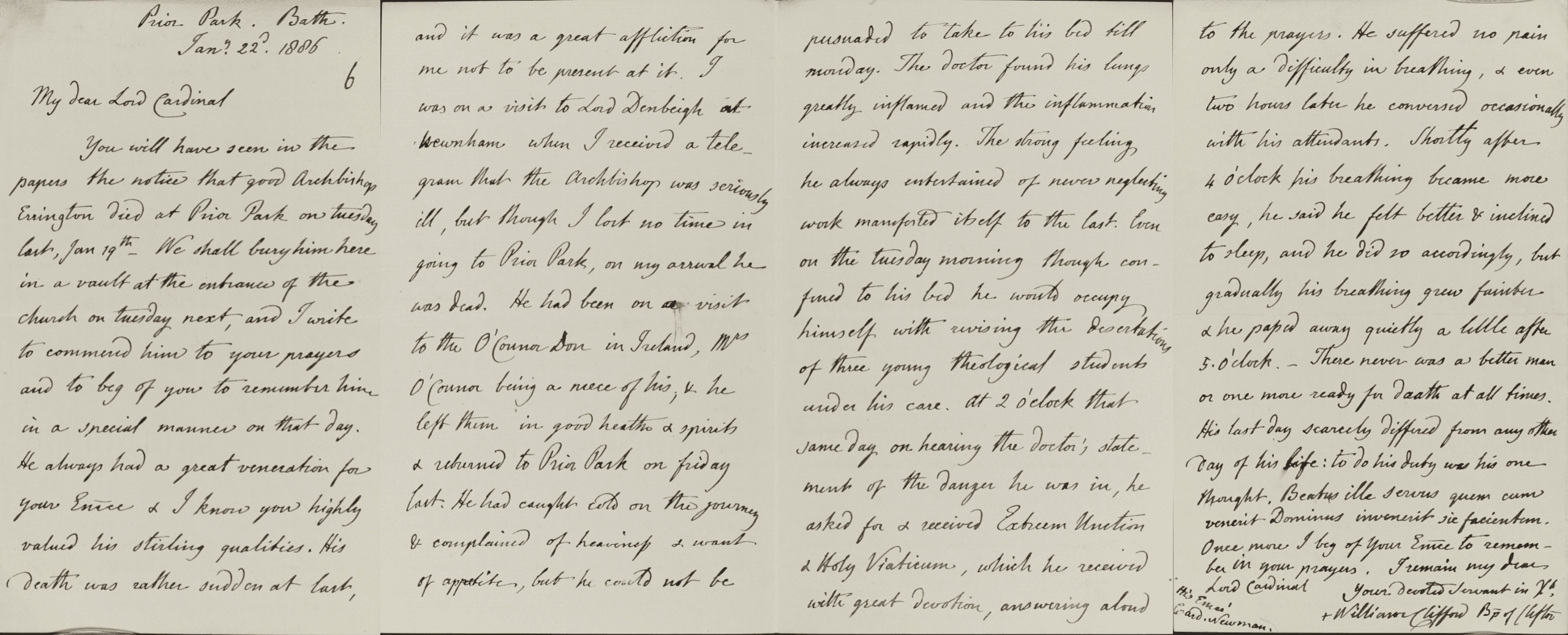
Clifford had plans to complete a course in canon law in Rome and did not take up the offer, but this letter began a lifelong correspondence between him and Newman. They often wrote to congratulate one another on publications, or to support each other in difficult times. When Errington died in 1886, Clifford wrote to Newman asking him to “commend him to [his] prayers,” expressing his grief over not being present at the time of death.9 Newman responded with deep sympathy:10 “A great gain for him, but what a loss, especially for you. Of course I said Mass for him at once.”11
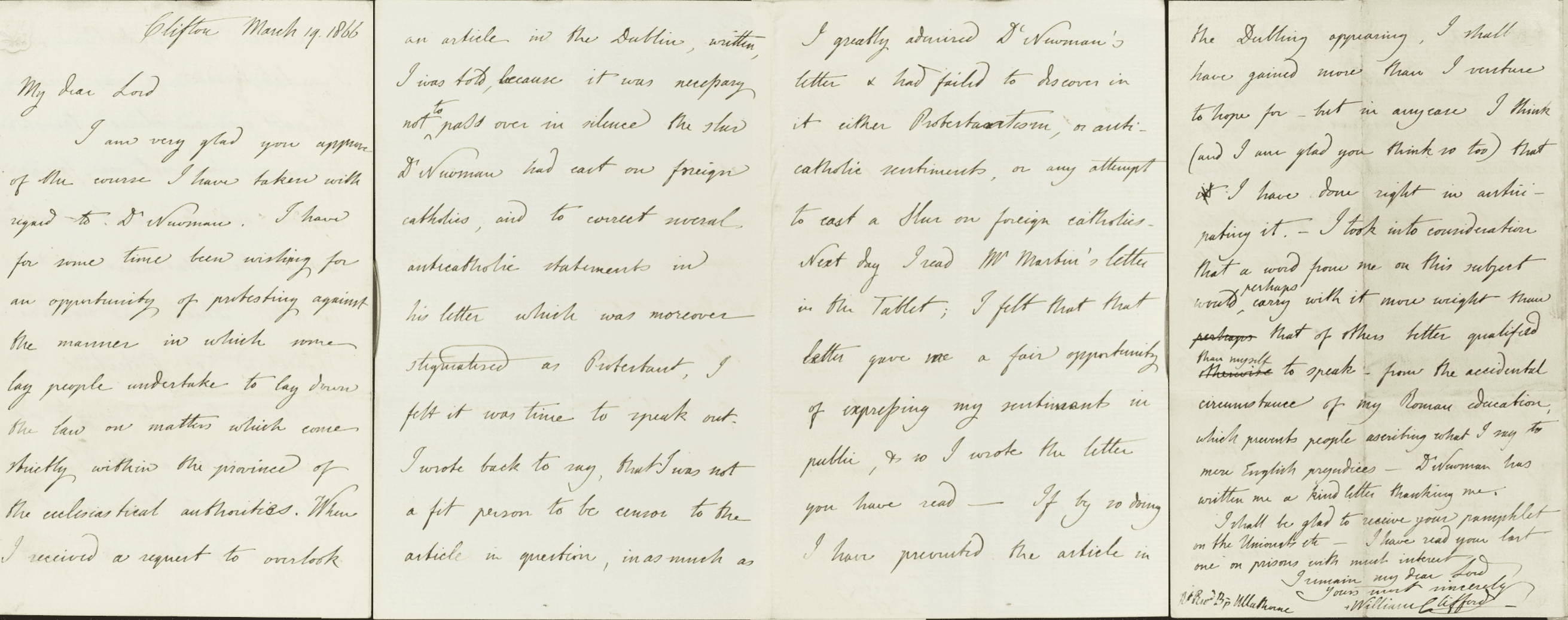
Clifford often wrote in defense of Newman and was a loyal supporter of Newman. In March of 1866, Clifford wrote to William Bernard Ullathorne, the Bishop of Birmingham, on the controversy in the Dublin Review concerning Newman’s supposed “foreign Catholic slur.” The two agreed to issue their own responses in Newman’s favor, refusing to endorse W. G. Ward’s piece on the matter. Their collaboration effectively blocked Ward’s response from being published and protected Newman from further scrutiny.12
When I received a request to overlook an article in the Dublin, written, I was told, because it was necessary not to pass over in silence the slur Dr Newman had cast on foreign catholics, and to correct several anticatholic statements in his letter which was moreover stigmatised as Protestant, I felt it was time to speak out. I wrote back to say that I was not a fit person to be censor to the article in question, inasmuch as I greatly admired Dr Newman’s letter & had failed to discover in it either Protestantism, or anticatholic sentiments, or any attempt to cast a slur on foreign catholics.13
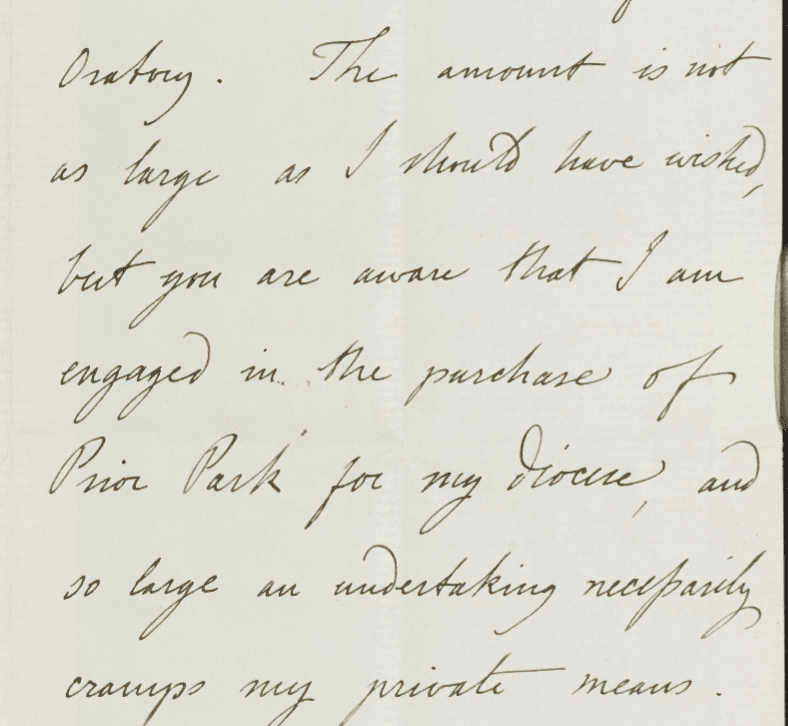
Clifford supported Newman’s attempt to establish the Oxford Oratory, donating personal funds in the hopes that the project would be successful.14 He also supported Newman’s project with the Birmingham Oratory to issue a new English translation of the Bible for Catholic laity, which was funded largely with Newman’s own personal finances. Ullathorne was in initial support of Newman’s efforts, but he expressed doubts after Wiseman pressured him to back down. Newman discovered via Clifford’s letter that plans for the Oxford Oratory would not proceed.15
Papal Infallibility
Leading up to the First Vatican Council, Clifford was in the minority as an Inopportunist on the subject of papal infallibility. Alongside Newman, Clifford believed in papal infallibility but did not believe it was the appropriate time for the council to define it or establish infallibility as dogma. Only two of the thirteen bishops of England and Wales joined Manning in signing the petition to define infallibility—Robert Cornthwaite of Beverly and Thomas Grant of Southwark. Clifford and Errington both publicly opposed the definition, as did Alexander Goss of Liverpool, who was not present at the council due to illness. Other bishops such as William Vaughan of Plymouth, Francis Kerril Amherst of Northampton, and William Turner of Salford held Inopportunist views but chose to recuse themselves from public debate.16
Newman’s view was that the pope is infallible in doctrinal matters but is not so in ecclesiastical or liturgical matters.17 His writings on infallibility were taken out of context by the ultramontane party, with circulating implications that Newman did not believe in the concept of papal infallibility at all.18 Newman held the belief that the pope could make infallible statements in an official capacity as head of the church (ex cathedra, or “from the chair”), meaning that the popes deserve “unreserved assent” from Catholics when taking a formal stance on doctrinal interpretation, because he is protected by God from teaching heresy in office.19 Newman believed that defining papal infallibility and expanding its reach—as the ultramontanes wished to—would portray the Catholic Church as a tyrannical organization to lay Catholics and Protestants who did not understand the nuances of infallibility.20 Newman did not enter public controversy over the matter, and he did not initially make his views public on his own volition. Instead, Ullathorne shared a private letter with Clifford, who made a copy for himself and shared Newman’s letter with Errington. Inevitably, the letter was leaked to the press and quoted in The Standard.21
Clifford did not share the letter with insidious intent. He was impressed with Newman’s conclusions on infallibility, having already come into his own philosophy on the subject, and wanted to share said conclusions with his closest companion. Ullathorne shared Newman’s letter with Clifford because he supported Ullathorne in wanting to amend the language referring to the church, believing that “Roman” gave the wrong impression to Catholics abroad.22
Clifford wanted the definition of infallibility to be seen “in the wider context of the Church,” calling for the council to consider the opinions of Protestants. Clifford argued that Protestants already had low opinions of the Catholic Church, claiming that the strict definition of infallibility the ultramontanes were calling for would paint Catholicism as oppressive.23 He feared that the dogma of papal infallibility would ostracize potential converts, and therefore he wanted the definition to be logical and coherent for non-clergy.24
Despite his position as a bishop and personal relationships with powerful men such as Manning, Clifford was not popular in the Curia. He was vocal in his opposition to defining papal infallibility leading up to Vatican I, and a 1962 biography of Manning calls him “the most truculent of the English Inopportunists.”25
Newman did not attend the First Vatican Council despite personal invitations from Clifford, Bishop Thomas Joseph Brown of Newport, and Pius IX himself. He declined the invitations on the grounds of poor health and lack of fluency in any language other than English,26 but Newman trusted that Clifford would be strong in his convictions. In a letter to Anglo-Irish politician William Monsell, 1st Baron Emly, Newman confided “except for Clifford, none of the English bishops could be relied upon” to oppose a definition of infallibility.27
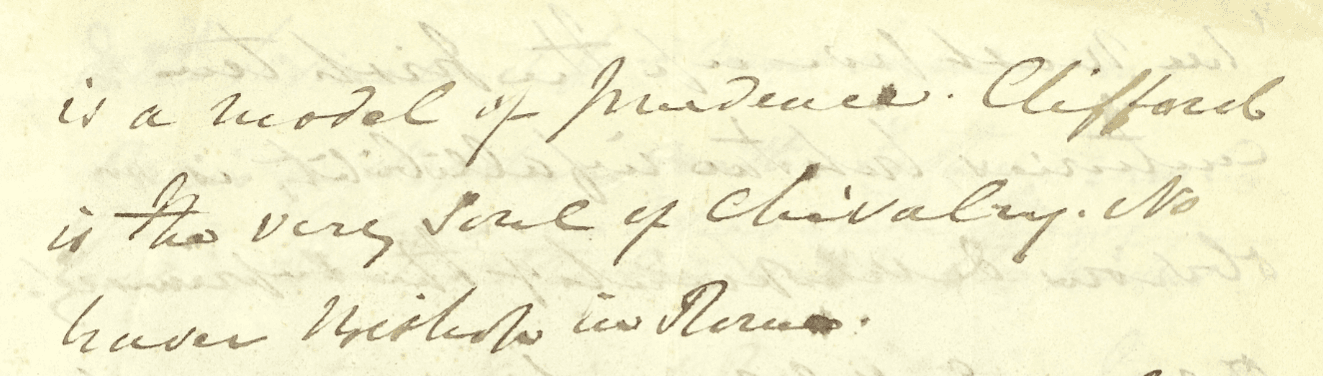
Of the English and Irish representatives at the council, only Clifford and Bishop David Moriarty of Ardfert took a strong Inopportunist line.28 In a letter to Newman during the council proceedings, Moriarty described Clifford as “the very soul of chivalry,” stating that there is “no braver Bishop in Rome.”29
On 25 May 1870, twelve days into formal debate, Clifford took to the council floor and spoke for almost an hour.30 Even through murmurings of disapproval and hostility to his position from other bishops, Clifford stood his ground, arguing that Protestants and lay Catholics would be unreceptive to a strict definition of infallibility that may represent the pope as a tyrant:
From this, it seems to me, one must come to the unavoidable conclusion that if we by this definition—whatever form it may take in the end—wish not to hinder but to help people, it is necessary that we do not give them a separate definition which relates to the infallibility and authority of the Roman Pontiff; but it is necessary that we clearly and logically demonstrate to them what is the nature and essence of the Catholic Church, what is the true authority in the Catholic Church, how the authority of the Church and the authority of the Pope come together, and how in all these matters it is neither tyranny nor despotism. But if, after so many months of labour, we have done nothing except to put before the people some decree about the Infallibility of the Roman Pontiff—no matter what way the decree may be worded—this will be the overriding impression of the people: that we had done nothing other than to constitute the Pope as a despot.31
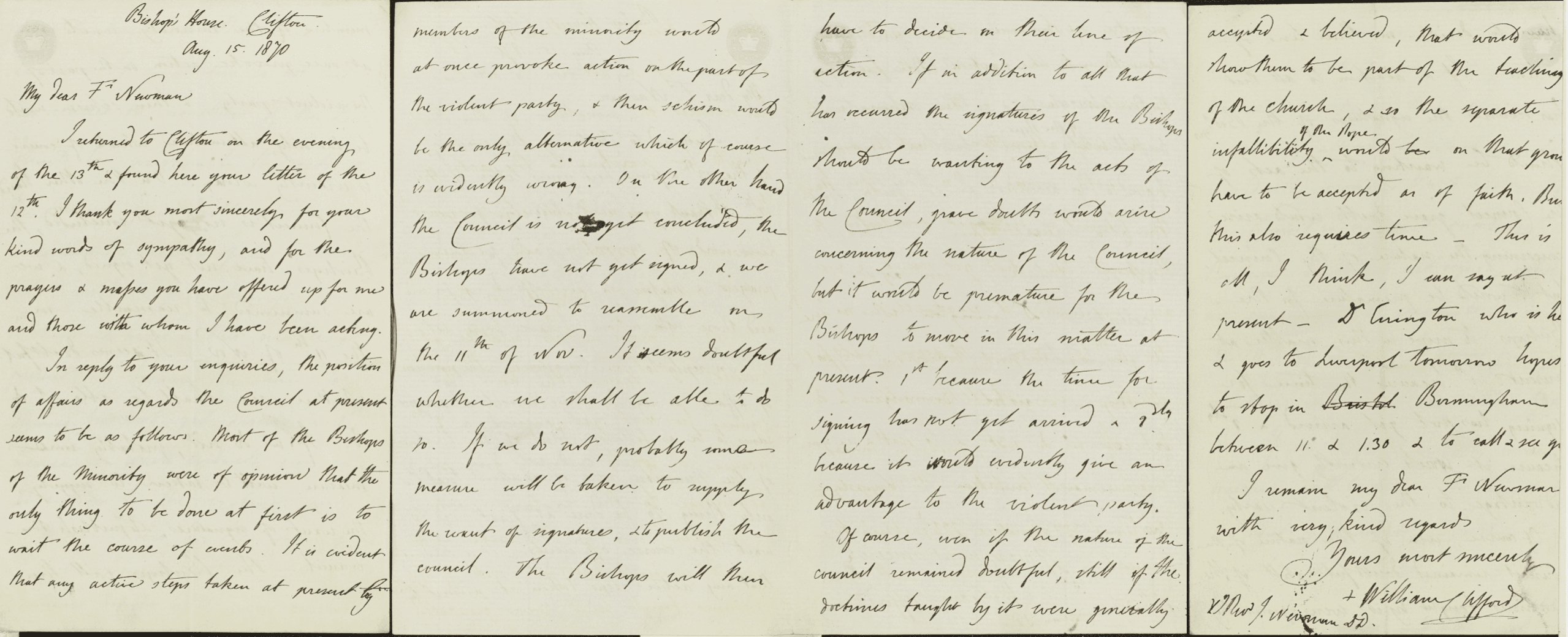
On 13 July 1870, Clifford was one of 88 bishops to vote non placet on the definition of papal infallibility as it was presented.32 In August 1870, Clifford wrote to Newman to update him on the situation after the council issued Pastor Aeternus:
In reply to your enquiries, the positions of affairs as regards the Council at present seems to be as follows. Most of the Bishops of the Minority were of opinion that the only thing to be done at first is to wait the course of events. It is evident that any active steps taken at present by members of the minority would at once provoke action on the part of the violent party, & then schism would be the only alternative which of course is evidently wrong. On the other hand the Council is not yet concluded, the Bishops have not yet signed, & we are summoned to reassemble on the 11th of Nov. It seems doubtful whether we shall be able to do so.33
Clifford feared retaliation from secular states and was concerned that they would view the Catholic position of infallibility as a political overstep: “The political impact of the definition, he argued, could be damaging, and so it proved.”34
Although the minority Inopportunists were not successful in blocking a formal definition of papal infallibility, Clifford’s steadfast objection to the definition demonstrated his personal convictions, as well as his ideological similarities to Newman. Clifford and Newman both recognized the potential danger in issuing a formal definition of papal infallibility and discussed this danger at great lengths. Their alliance was not a footnote in Newman’s life, nor was it inconsequential in the greater scheme of history. Their concerns over a formal definition of papal infallibility can be seen as the more moderate counter argument to what was declared as dogma on 18 July 1870 with the promulgation of Pastor Aeternus by Pope Pius IX.
1 Clifford (1823–1893) served as the third Bishop of Clifton from 1857 until his death at the age of 69. He is best known for his role in the debates over defining papal infallibility during the First Vatican Council.
2 John A. Harding, Clifford of Clifton (1823–1893): England’s Youngest Catholic Bishop (Alexander House, 2011), 349–51. A copy of Clifford’s eulogy for Newman is available in the NINS Digital Collections.
3 Harding, Clifford of Clifton, 29.
4 Edward Norman, The English Catholic Church in the Nineteenth Century (Oxford University Press, 1984), 356.
5 Harding, Clifford of Clifton, 40.
6 Harding, Clifford of Clifton, 33–34.
7 Harding, Clifford of Clifton, 31.
8 John Henry Newman to William Clifford (18 August 1854), LD, 16:223–24.
9 William Clifford to John Henry Newman (22 January 1886), NINS Digital Collections.
10 Harding, Clifford of Clifton, 140.
11 John Henry Newman to William Clifford (25 January 1866), LD, 31:111–12.
12 Garrett Sweeney, Bishops and Writers: Aspects of the Evolution of Modern English Catholicism (Anthony Clarke Books, 1977), 25–26.
13 William Clifford to William Bernard Ullathorne (19 March 1866), NINS Digital Collections.
14 William Clifford to John Henry Newman dated (05 February 1867), NINS Digital Collections.
15 Juan R. Vélez, Fr. Passion for Truth: The Life of John Henry Newman (TAN Books, 2012), 538–40.
16 Butler, Dom Cuthbert. The Vatican Council, 1869–1870: Based on Bishop Ullathorne’s Letters (The Newman Press, 1962), 176.
17 Vélez, Passion for Truth, 211.
18 Vélez, Passion for Truth, 565.
19 Stanley L. Jaki, Newman’s Challenge (William B. Eerdmans, 2000), 232.
20 Vélez, Passion for Truth, 567.
21 Champ, Judith. William Bernard Ullathorne 1806–1899: A Different Kind of Monk (Gracewing, 2006), 372.
22 Champ, William Bernard Ullathorne, 363.
23 Champ, William Bernard Ullathorne, 168, 184.
24 Harding, Clifford of Clifton, 171.
25 Vincent Alan McClelland, Cardinal Manning: His Public Life and Influence 1865–92 (Oxford University Press, 1962), 102.
26 Sweeney, Bishops and Writers, 30–31.
27 Ian Ker, John Henry Newman: A Biography (Oxford University Press, 1988), 633.
28 Butler, The Vatican Council, 114.
29 David Moriarty to John Henry Newman (20 February 1870), NINS Digital Collections.
30 Butler, The Vatican Council, 311.
31 Harding, Clifford of Clifton, 173.
32 Butler, The Vatican Council, 400–402.
33 William Clifford to John Henry Newman (15 August 1870), NINS Digital Collections.
34 Champ, William Bernard Ullathorne, 386.

Simon McMullen
Simon McMullen is a graduate student in the Public History program at Duquesne University, with intentions to pursue a career in archives/collections management. He was a Digital Humanities intern at NINS during the Spring 2026 semester. His historical interests are the First World War and the Interwar Period, with a focus on labor movements and LGBTQ+ history.
Topics
Newsletter

National Institute for Newman Studies
QUICK LINKS